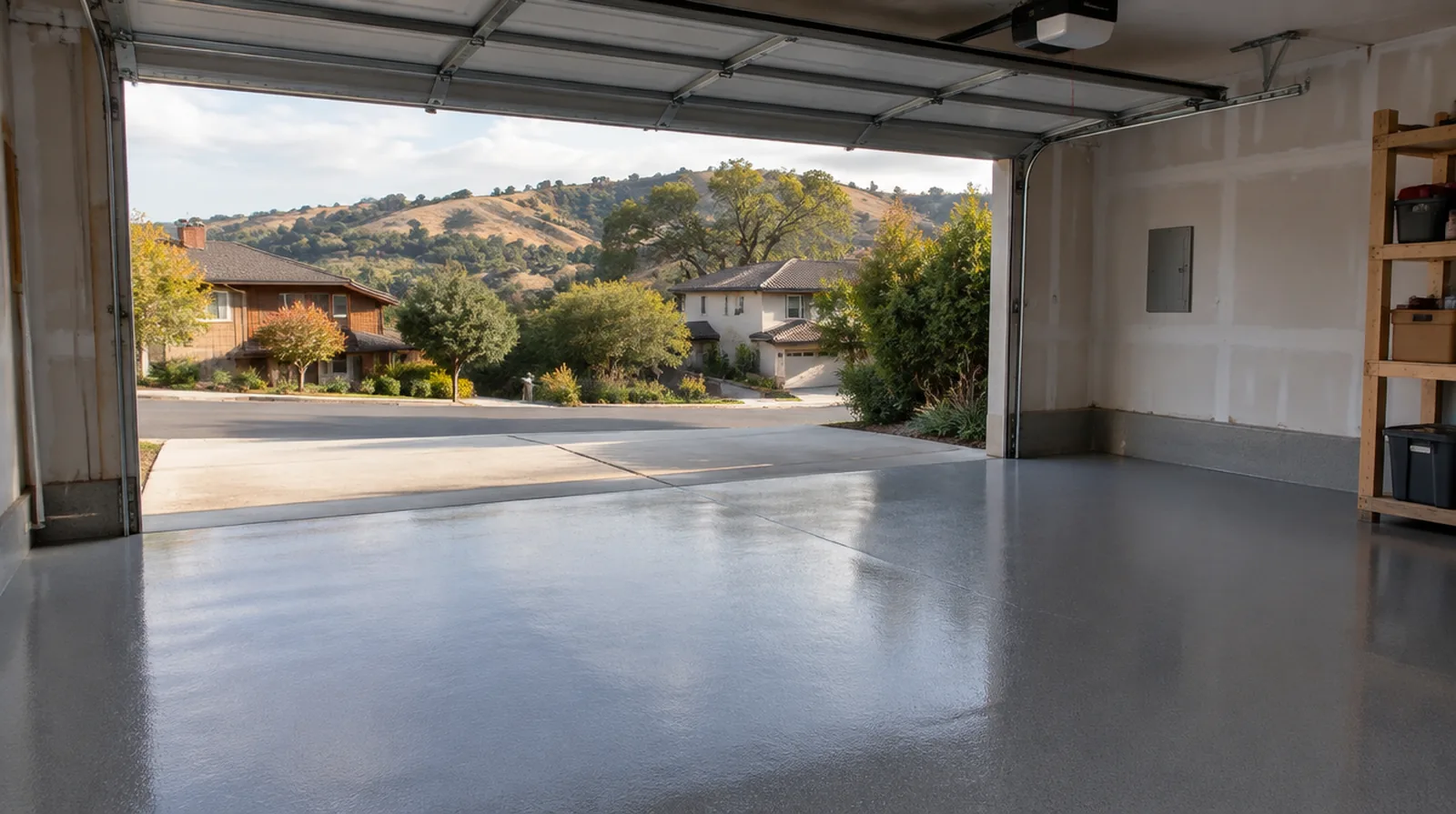
Start with the slab
Every garage begins with a moisture reading. Then we diamond grind the floor to remove sealers, paint, efflorescence and the weak top layer. Cracks, including the long ones that often run parallel to a retaining wall, get filled and ground flush.
Build the coating
We roll a primer suited to the moisture level, a pigmented base coat and, for many homeowners, a full chip broadcast. A clear topcoat seals it in and takes the daily wear.
Steep driveways and hot brakes
Cars coming down a steep hillside driveway arrive with hot brakes and tires. Cheap coatings soften under that heat and lift. A properly bonded system resists it, especially with a quality topcoat.
Basement-level garages
In homes where the garage sits below living space, the floor stays cool and can sweat in humid weather. A sealed floor is easier to dry and does not hold the musty smell bare concrete can.
Dust and silica
Our grinders are connected to vacuums to control silica dust. OSHA has a useful overview of why that matters.
How long does it take?
Usually two days to install and several more before parking.
Do I need to empty the garage?
Yes, wall to wall.
A Castro Valley garage floor, step by step
Garage floor epoxy in Castro Valley starts with a moisture test, because many garages here are built into hillsides. Then we grind the slab, fill cracks and spalls, and apply a primer. The body coat comes next, with color or flake, and we finish with a clear top that handles tires, tools and the occasional drip from a car parked after a wet drive home on 580.
Garages under living space
Many homes have bedrooms or a family room above the garage. We use low-odor products, seal off doors into the house and ventilate to keep fumes out of living areas.
A question we hear a lot
Can you coat a garage with a sloped floor? Yes. The coating follows the slope, which also helps water drain to the door.
Tight streets and steep drives
Our grinders and vacuums are portable, so a narrow street or a steep driveway is rarely a problem. We may park a little farther away and roll equipment down. Let us know about any parking limits on your block when you book the estimate, and we will plan around them.
How we coat a sloped Castro Valley garage
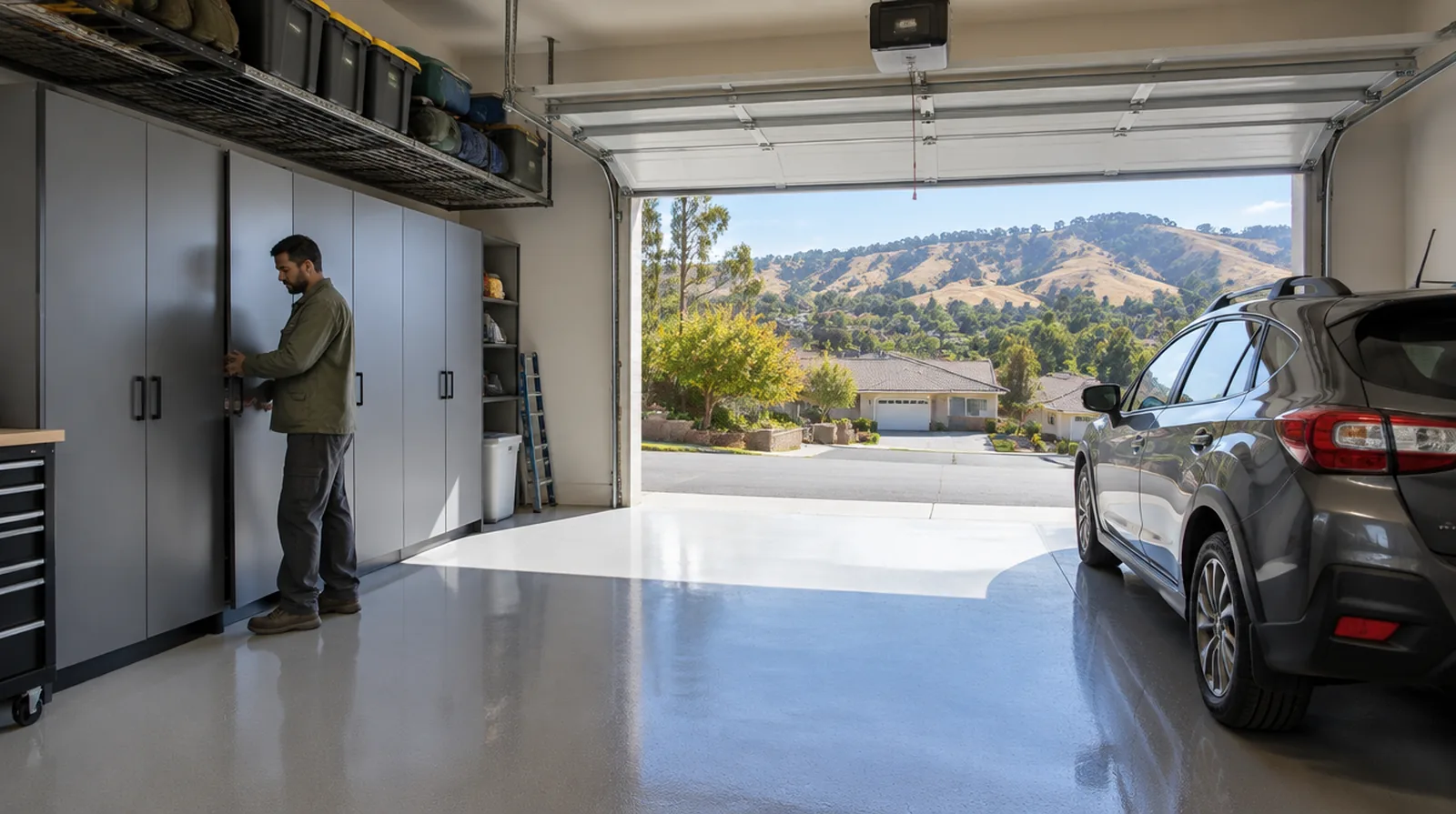
Most garages in town are not flat, and they are not meant to be. Builders pitched the slabs so water drains toward the door, and on hillside lots that pitch can be steep. Before we quote, we check how much the floor falls, where water collects, and whether the slab has settled near the driveway joint. That tells us how to stage the job.
On a sloped slab we mix smaller batches and work from the high back wall toward the door so the resin does not creep downhill while it is still wet. The goal is an even film thickness across the whole floor, not a thin coat at the top and a puddle by the door.
Common problems we find here
Old garage paint that has peeled under hot tires, oil soaked into the low side where cars drip, and spalled edges at the threshold are the three we see most. Each is handled during prep: the paint is ground off, oil is degreased and ground back, and broken edges are rebuilt with repair mortar before the base coat goes down.
Choosing a finish for your garage
A solid color gives a clean look and suits a garage that doubles as a gym or workshop. A chip finish hides dust and tire marks better, which helps on a busy floor. We bring sample boards so you can see the colors in your own light, since a north-facing garage and one that gets afternoon sun can make the same blend look quite different.
Living with the new floor
You can usually walk on the floor the next day and park on it a few days later, depending on the system and the weather. After that, a broom and a mop are all it needs. We leave written care notes before we go.
Get a garage floor that lasts
Call (510) 931-7265 for a free estimate.