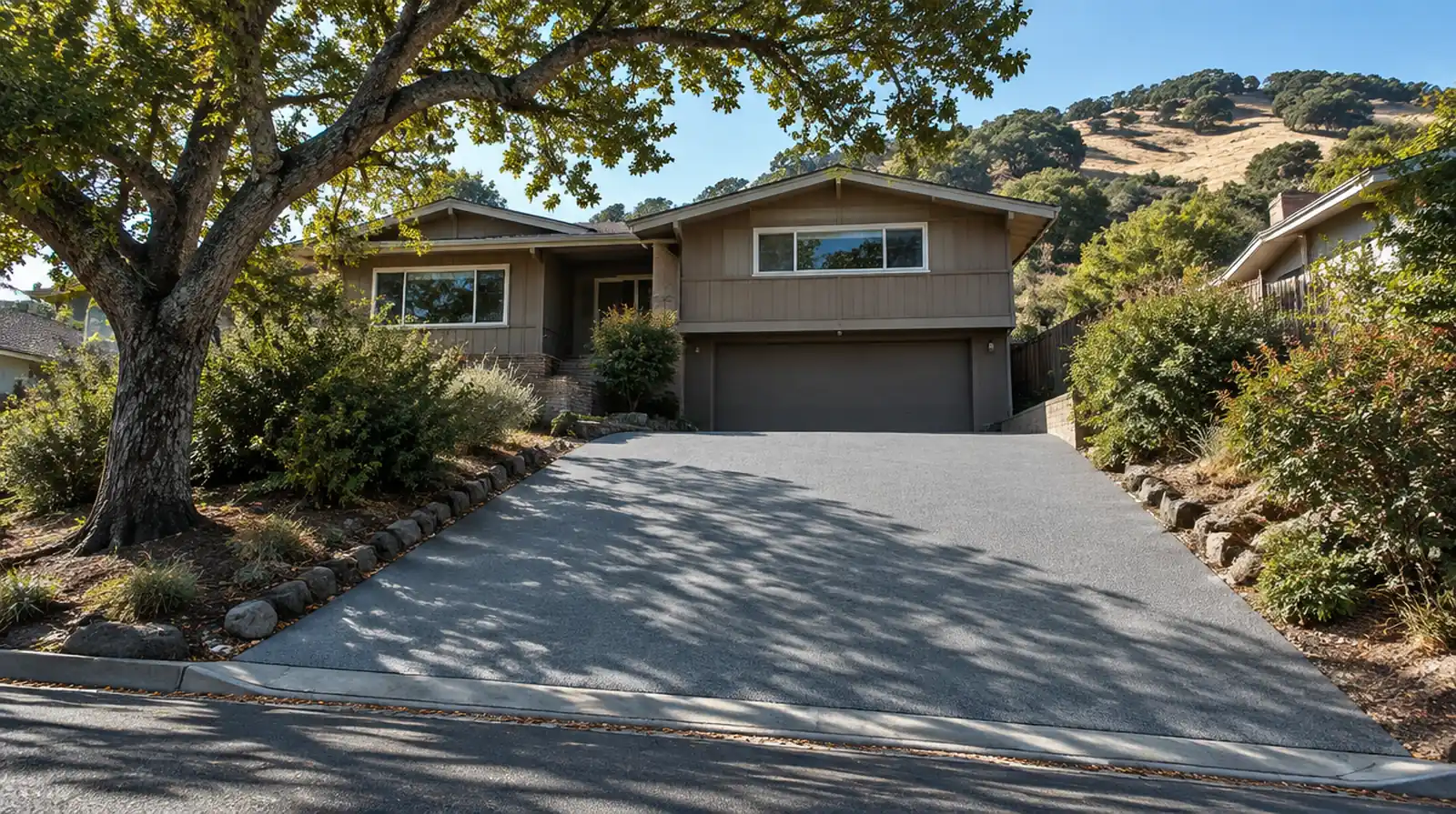
Driveways on a slope need a different plan
A flat suburban driveway can take almost any outdoor coating. A Castro Valley driveway that climbs from Redwood Road or one of the streets above Lake Chabot cannot. On a grade, a smooth topcoat turns slick the first time the winter rains come, and tires spinning on the steepest stretch scuff a soft coating quickly. So every hillside job here starts with traction. We broadcast fine aggregate into the final coat and use a heavier grit on the steepest part of the run and on the flat landing in front of the garage door, where people step out of the car.
Slope also changes how we apply the material. Resin wants to run downhill before it sets. We mix smaller batches, work across the drive in short bands from the top down, and choose products with a working time that suits the temperature that day.
Oak leaves, tannin and winter runoff
Coast live oaks shade a lot of the older streets in town, from the Village area out toward Crow Canyon. They are beautiful trees, but their leaves and acorns sit on bare concrete through the rainy months and leave brown tannin marks that bleach and scrubbing never fully remove. Runoff from the hills carries silt across driveways at the bottom of a slope, too. A sealed, coated surface keeps those stains on top, where a hose and a soft broom will lift them.
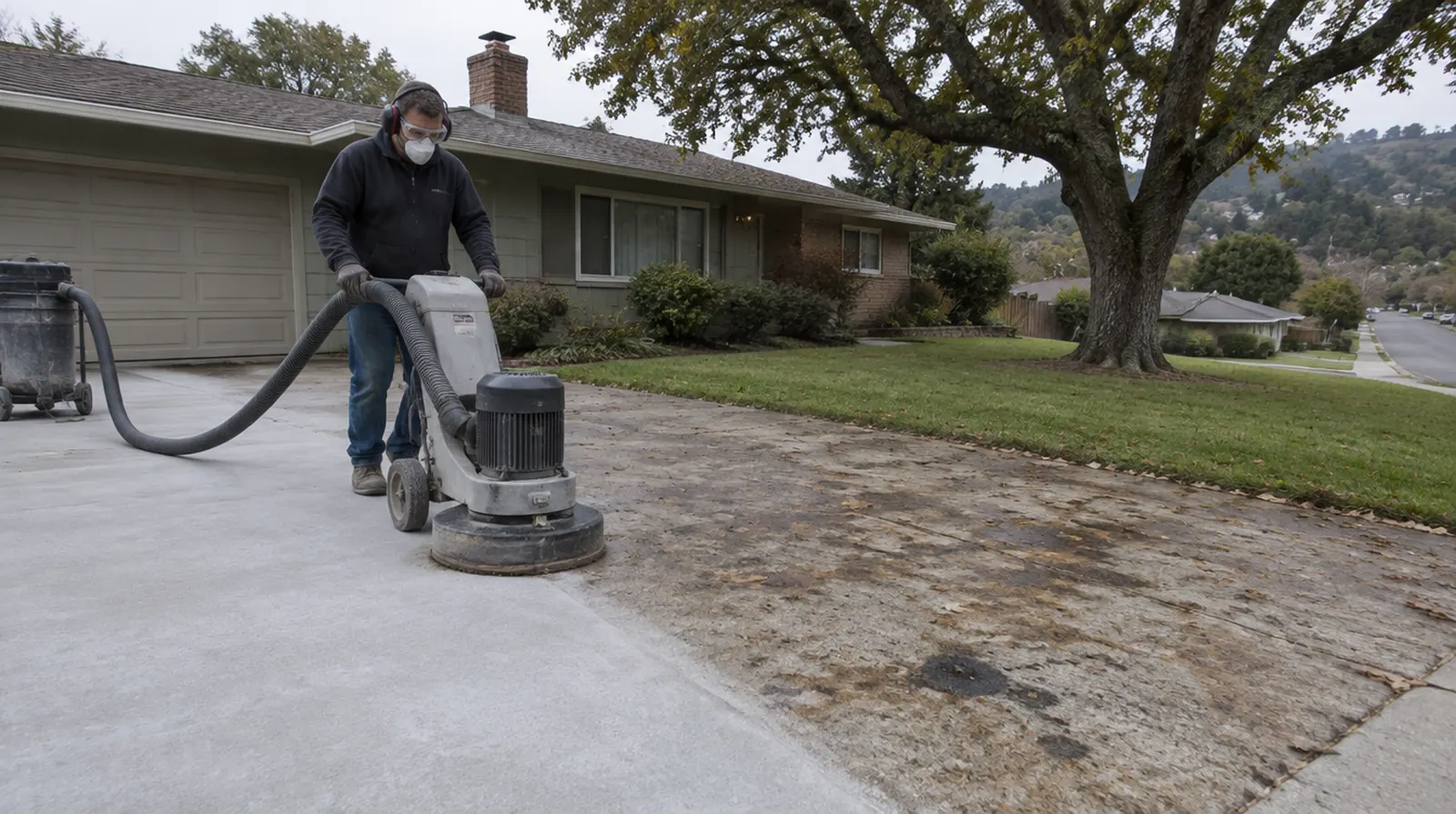
Before we coat, we grind away as much of the old staining as the concrete allows. Deep tannin marks may still ghost through a light color, so we often suggest a mid-tone gray, tan or a flake blend for oak-shaded drives.
Old slabs, new slabs and the fault line
Much of Castro Valley was built out in the 1950s and 1960s, and many of those driveways are now 60 or more years old. They often have hairline cracks, a few heaved panels and patches from old plumbing or sewer work. The Hayward Fault runs along the west side of the valley, and the expansive clay in the hills shrinks in summer and swells with winter rain. All of that means cracks will keep moving a little. We fill stable cracks before coating, and for cracks that clearly move with the seasons, we use a flexible filler and let the line show rather than pretend a coating will hold it closed.
Newer driveways in Five Canyons, Palomares Hills and other developments up the hill are usually in better shape. They mostly need a good grind, cleaning and the right primer.
If a panel has sunk or broken into pieces, coating it only hides the problem for a while. We point those out at the estimate so you can repair or replace that section first.
Materials made for California sun
Indoor garage epoxy yellows and chalks in direct sunlight, so we never put it on a driveway. Outside, we use UV-stable polyaspartic and polyurea coatings. They hold their color through long, dry summers, stay flexible as the slab warms and cools, and cure fast enough that most driveways are done in one or two days. For homes that want more pattern, we broadcast a flake blend and lock it in with a clear textured topcoat.
How a driveway job goes
- Estimate. We measure the drive, check how steep it is, take moisture readings and look at every crack and stain.
- Prep. Leaves, moss and silt come off, oil spots are degreased, and the concrete is diamond ground so the coating can grip.
- Repairs. Cracks and chipped edges are filled and ground flush.
- Coating. Primer, color coat and a textured topcoat go down in bands from the top of the drive.
- Cure. You can walk on it the same day. Most cars can come back after about 24 hours, longer if the weather is cool and damp.
On tight streets we plan where our trailer goes and how you will get your cars out before we start, since many homes up the hill have no street parking on one side.
Looking after a coated driveway
Rinse it off a few times a year, more often under oak trees in the fall. Clear leaf piles before the first big storm so they do not sit wet for weeks. Wipe up oil drips when you see them. A coating that takes a hard hit from a dropped tool can usually be spot repaired and topcoated.
Questions about driveway coating
Can you coat just the steep part of the driveway?
Yes. Some owners coat only the upper section and the landing, or just the apron by the garage. We will make a clean edge where the coating stops.
Is this the same as sealing?
No. Concrete sealing soaks into the surface and changes its look very little. A coating builds a colored, textured layer on top.
Do you work in nearby towns?
Yes. We coat driveways in San Leandro, Hayward, Dublin and the unincorporated areas around Fairview and Cherryland.
Get a price for your driveway
Call (510) 931-7265. We will measure the drive, check the slope and moisture, and give you a written quote.